
Your Cart is Empty
The Early Days
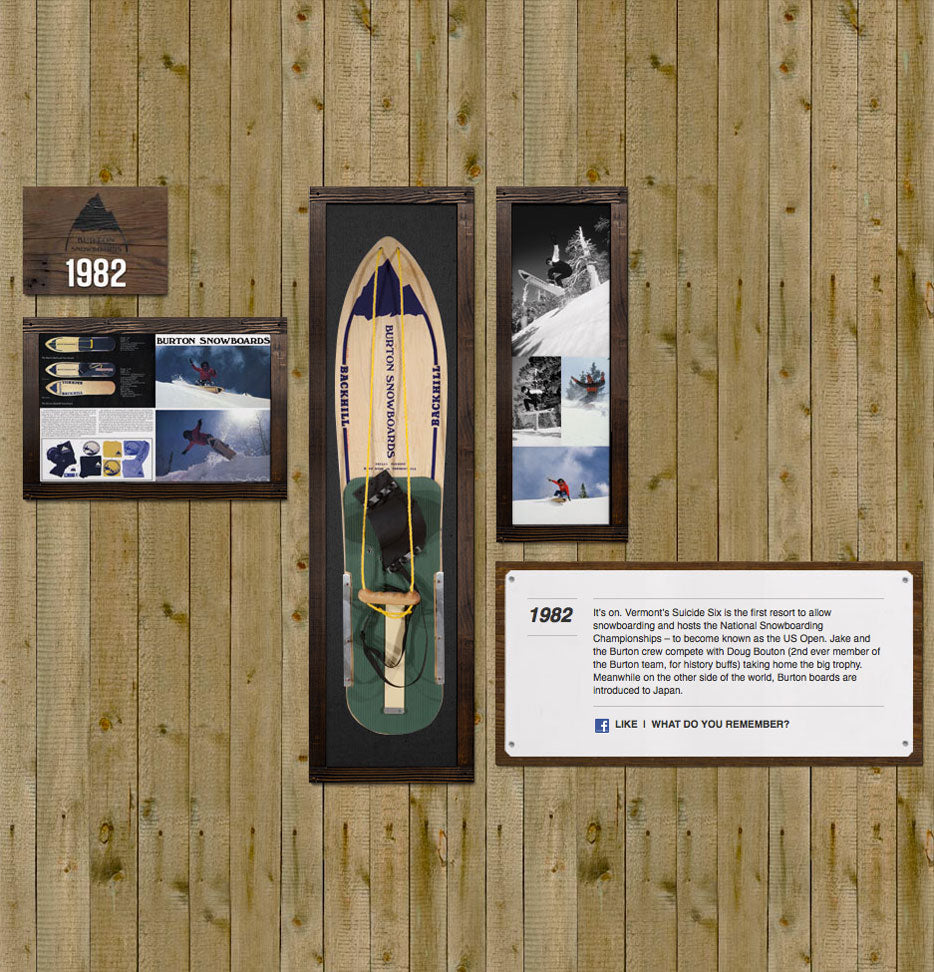
While there are numerous arguments as to who actually created the first snowboard, not many disagree that it was Jake Burton Carpenter who truly developed and pioneered the sport on a national and global level. Starting manufacturing in 1977, Jake and his company merely capitalized on the idea of sliding on snow for entertainment. Many inventors throughout the years have developed versions of the modern day snowboard. In 1926 Howard J. Ferris patented a stand up sled named the Skeeboggan. Others followed in his footsteps and most notably Sherman Poppen patented the Snurfer in 1965. He later partnered with Brunswick (yes the bowling company) to market his product. They decided to distribute the Snurfers to thousands of hardware stores throughout the country. While Sherm sold over half a million Snurfers, he never fully realized the Snurfer's true potential. Had Brunswick distributed Snurfers to sporting goods stores, who knows how snowboarding history would be written. Believe it or not the Harvard business school used Sherm's Snurfer misfortune to teach what not to do.
It is said Jake Burton Carpenter was inspired by the Snurfers he rode as a teenager. Like many innovators Jake never seemed satisfied; always trying to improve on his designs. All through high school and college he tinkered with his inventions and finally after quitting his job at a Manhattan investment bank in 1977, he got a break that ultimately founded Burton Snowboards; an inheritance from his grandmother of $20,000. As for the reasons he quit..."I wasn't loving it," he recalled "But I got to talk to the entrepreneurs whose businesses we were selling. I was amazed that they didn't intimidate me. I remember … thinking, 'This isn't any tougher than the lawn-mowing business I started in high school.'"
Jake, now 23 years old, with his degree in economics and his newly acquired bank roll, moved to Stratton Mountain, Vermont to work nights as a bartender and days on his snowboards. 100+ designs were created from wood and various laminated materials before he settled on a marketable product. Only problem, it was now summer and no one wanted to buy. Jake's perseverance is what saved his dream of not only creating a truly superior product, but also inventing the sport in the first place.
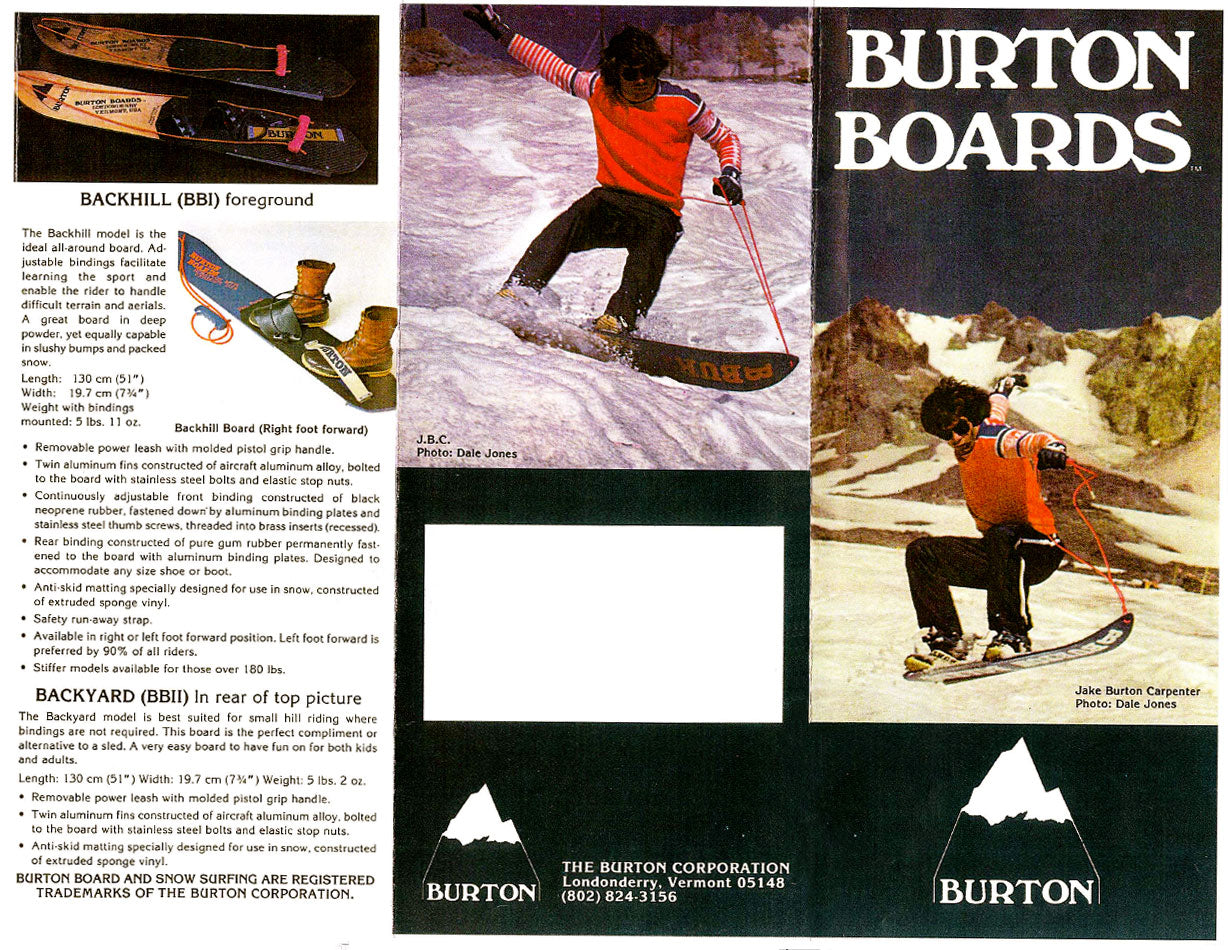
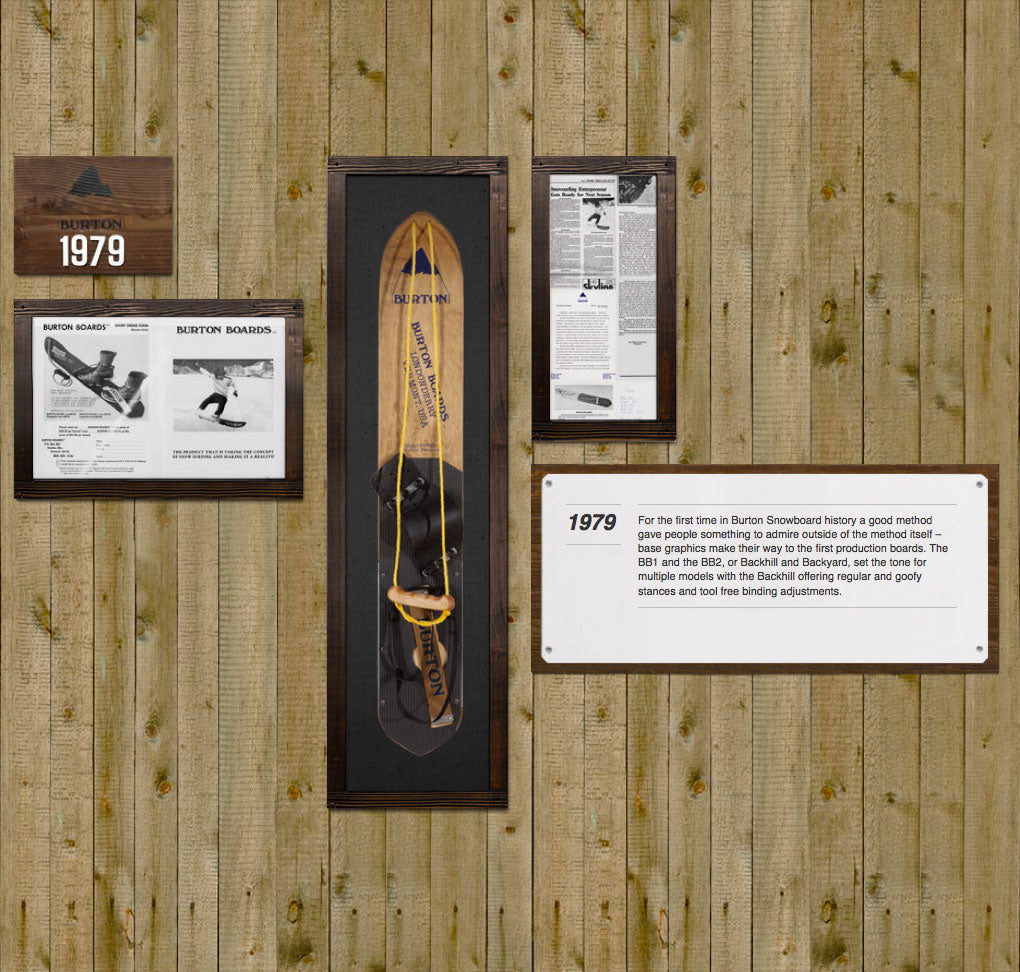
The following winter he took a hiatus in Europe to ride the glaciers of Austria. His head now cleared, he returned with an increased vigor that seemingly never slowed. He spent the winter season of 1978-79 peddling his product at various trade shows all throughout the country. Jake recalled, "I was afraid to go to the bathroom, I thought if I did, I might miss my only customer." Throughout the winter he sold over 300 boards, attributed to his new marketing campaign (which by the way included a 'mail-order' department whose telephone rang in Jake's bedroom). In the end he was still in the red, spending more money than he was taking in. Never one to rest Jake took it to the next level and decided to gain product awareness by winning a national Snurfer competition. After convincing race directors to allow him to use his own board in an 'open division', Jake took the crown and turned the corner for his struggling business. After seeing Jake dominate the competition not one rider wanted to compete ever again with their $10 Snurfers (sorry Sherm).
1980's and Beyond
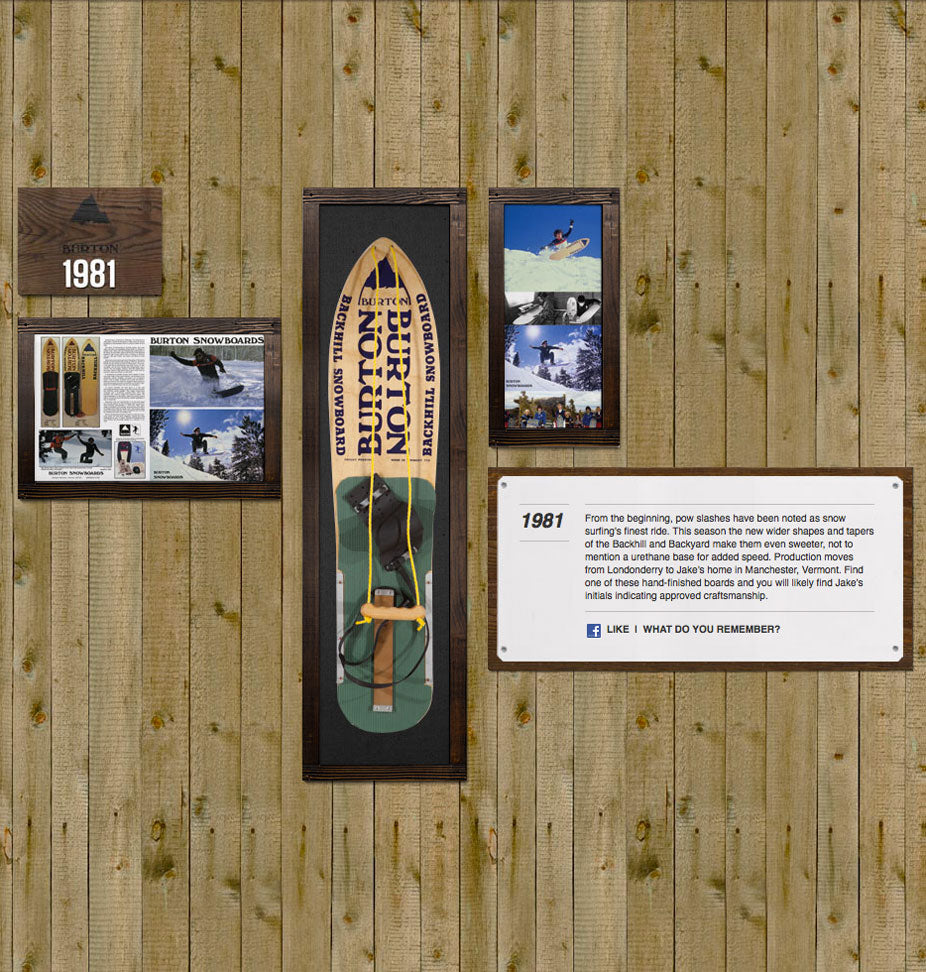
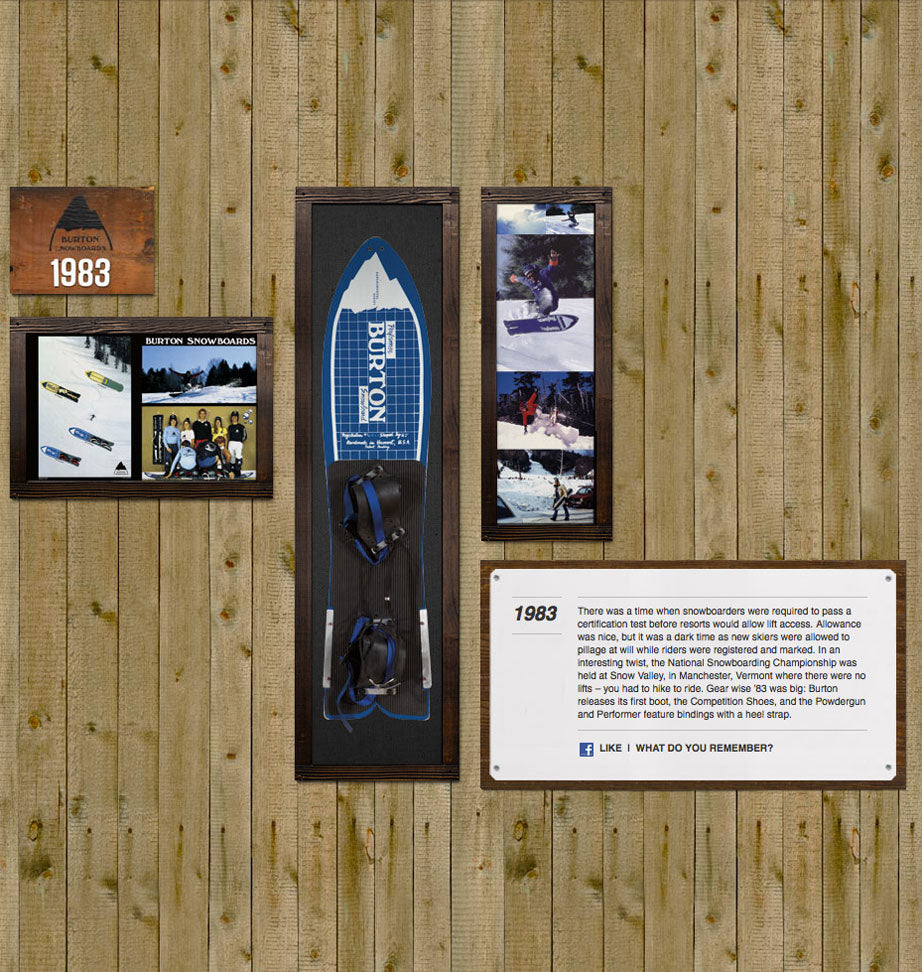
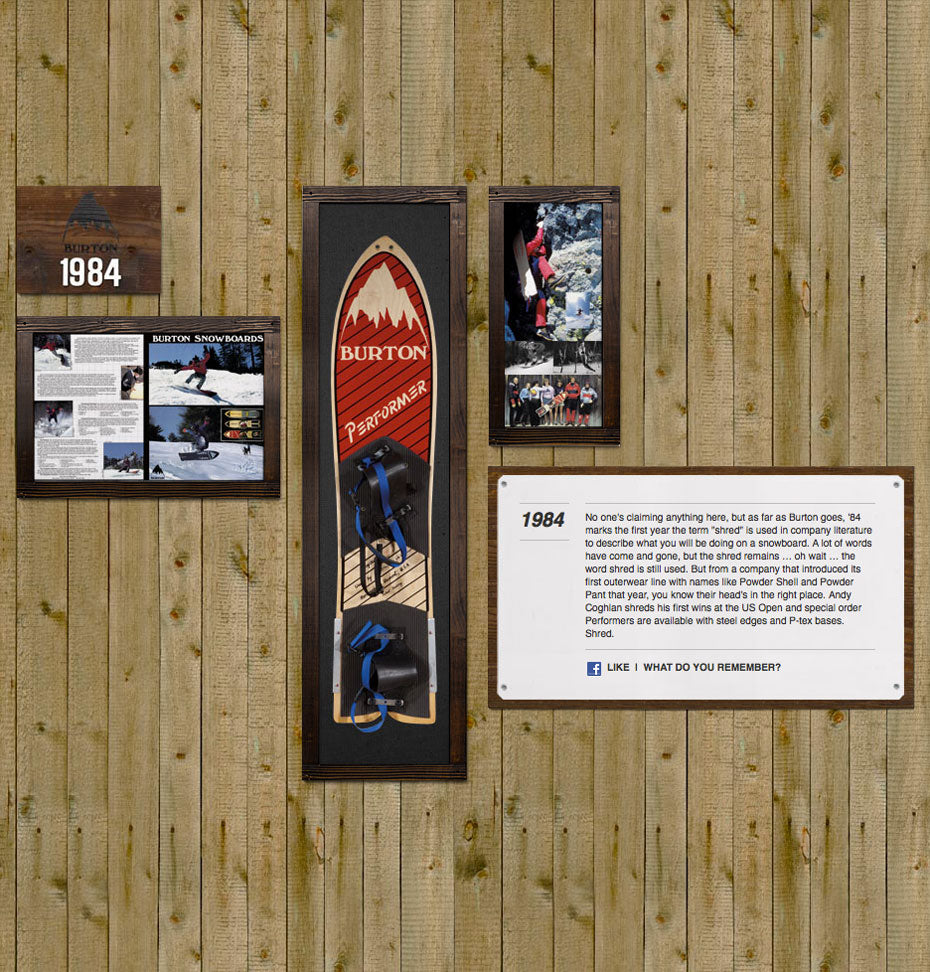
Jake limped along throughout the 1979-80 winter season with just over 700 boards sold. Although this was double his previous years sales, he was still operating in the red in 1981 with financial losses adding up to $130,000. Jake was not alone in his struggles to grow the sport and he along with others finally pushed the envelope with advances in technology that spurred the soon to be, fastest growing sport in the country. By 1984 Jake with his newly developed metal edge snowboards broke $1,000,000 in sales finally realizing the profit he deserved. It is noted to vintage Burton snowboard collectors that Jake changed his name in 1984 from Jake Burton Carpenter to simply Jake Burton to avoid confusion.
The golden break began at Vermont's Stratton ski resort, who became the first in the country to allow snowboarders to ride its slopes (thanks to Burton's efforts). Slowly by surly other resorts followed suit. In 1985, 93% of the ski areas in the U.S. had banned snowboarding, by 1995 over 90% not only allowed it but catered to snowboarders with specific marketing campaigns aimed at gaining their business.
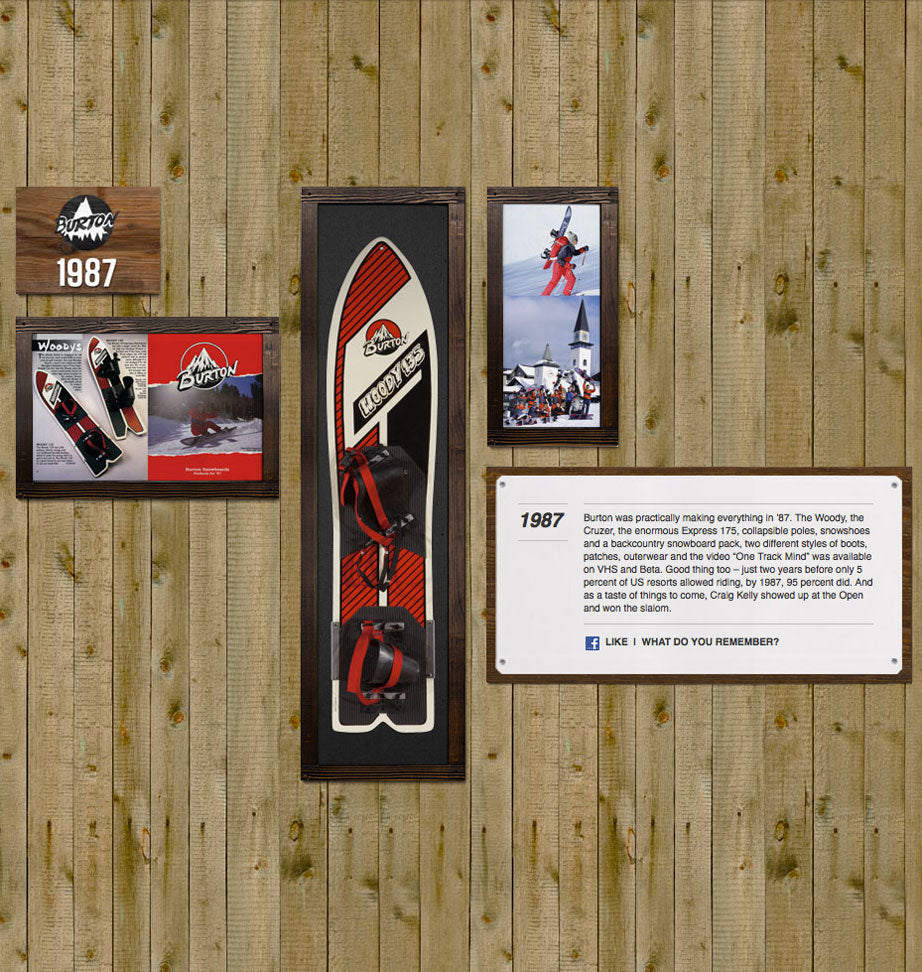
Jake's momentum increased yet again with the opening of a manufacturing plant in Innsbruck Austria in 1985. From there on out sales rose on an exponential level realizing over 100,000 snowboarders by 1987.
If you have any questions about vintage Burton snowboards send us an email and we will gladly get back to you.







Article by © Vintage Winter

This is probably a “hail-Mary”, but my husband had a 1984 Burton Performer that got lost years ago. I actually my Mom took it to the thrift store not realizing what it was. Then, by some miracle he actually found it online back in 2019 and then we lost track again. I would LOVE to find it for him as a gift. You will know it was his because there are “conversation piece carvings” in the mountain logo above the Burton. It actually says “AJ Nunn”. His name! If anyone comes across it – could you email me: heathernunnmusic@gmail.com

I have a RED 1985 Burton Performer Elite 140 with original bindings for sale. Almost everything I have seen posted of this model, has been the black model. Again, this is the RED model. It’s in really good shape. If interested email me at gconrad32me@gmail.com

hi everybody, looking for people who wanna sell their old burton boards. i’m located in austria, sellers from eu would be awesome, but also the other ones from abroad- PLEASE contact me: iris.prenner@gmail.com -don’t be afraid to offer EVERYTHING! thanks and big hugs, iris :)

Selling a DEMO Vintage Craig Kelly Mystery Air Burton Snowboard with Original Bindings on ebay: https://www.ebay.com/itm/133500509060. Same as that featured on this site.
Let me know if interested! kuyperfamily@gmail.com

Visa
[url=http://www.g5903vh4th7i4vz82ym11pyq76s6x2f8s.org/]udtipmijifw[/url]
adtipmijifw
dtipmijifw http://www.g5903vh4th7i4vz82ym11pyq76s6x2f8s.org/

circa 1985 Burton Backhill available. Great shape-with some wear (chips/splits). Bindings intact. Contact aaron.project.object@gmail.com if interested.

I’m selling a burton performer elite 130 just write a bid with who has interest (Richard.Wolfgang@gmx.at

Any seller in Europe??? Send me a line. Thxxx!!!

Ken
Send me info regarding board for sale to sicamoose@gmail.com
Cheers!

I have a Burton Safari 2 with bindings and an Avalanche (Damien Sanders) 165 for sale if interested. Thank you.
Hi Dudes
Im looking for Burton Kellys here in Europe. I´m in Spain.
Big hug for everybody!!!

I have a Burton Performer Elite 130 w/ original Burton carrying bag that I’m looking to get rid of.
This is a Vintage classic from the 80’s
Contact:
zanecaden19@gmail.com

I have a Burton Blackhill snowboard with binding from 1984. It is in excellent condition. It is missing the rope on the front of the board. It is signed by Jake Burton and Burton Snowboards has authenticated the signature. I’m not sure what it is worth but I am interested in selling it. It was willed to me by my deceased brother that lived in Vermont in the 1980s.

Hi, my fiance and I have a 1983 Rare Vintage Burton Backhill Snowboard that we would like to sell. We would prefer not to use Ebay and was hoping for some advice on additional ways we can sell it and find the right collector? The board is in good condition with some wear from being used in the 80’s. He has owned it since the late 80’s and stored it inside ever since. Any help is greatly appreciated! Thanks!!
malory.bowen@yahoo.com

I have a Burton Backyard 1983 for sale in great condition. Serial AJ 118 A
email me for pictures or with interest: sethharwood at gmail dot com

I have the 1980 Burton in pristine condition. Bought it new, used 4 times. I’m thinking of selling it. Anyone have any idea how much it’s worth. Thanks. taylor1harper@aol.com

Looking for new or very good condition Factory Primes from 1999 (yellow top)

Hi I have a pair of 84-87 burton bindings that I am trying to price they are red and have high backs they are made in Italy and have no patent because it was before they put the patent on their stuff. It would be great if you could email me an estimated price and date! Thanks so much

I’ve got a 89 Burton Cruise and 91 Craig Kelly air I’m looking to sell. Been in storage for decades since my old riding days. Hit me up at my email for pics and to discuss pricing.

I have MANY years experience in helping with values of old snowboards and helping them being sold for top dollar. 970-331-4616 is my cell, snowshred73 at gmail is my email.

Ha! Ooops ashnewnes@hotmail.com

i have an early 1980s sims split tail board.
what do you think its worth?
who would want to buy it?
its in VERY good condition.
thank you #wgp

Hi, I’ve a Mystery Air of 89 made in Austria which was sanded and repainted. The Board was all black but the yellow striped big"B" seems to be also purple striped !
Is anybody can help me with a color schema to refresh it?
thanks a lot. fox3@orange.fr
Hi, I’ve a Mystery Air of 89 made in Austria which was sanded and repainted. The Board was all black but the yellow striped big"B" seems to be also purple striped !
Is anybody can help me with a color schema to refresh it?
thanks a lot. fox3@orange.fr

Hi,
Actually looking for vintages boards, specially a Burton Elite. If any of you got one or any other vintage board, drop me a line.
Thanks

I have a 1984 burton performer good used condition, deck is clean bottom has some scarring.bindings and runaway strap are intact. Signed by. Coughlin and Jake Burton Carpenter. If your interested. Let me know quickly otherwise I’m selling it on capitalist.

We have a Burton Backhill BBI 1980. I believe that is what it is. It is blue and orange. My husband is original owner and we are looking to sell it. Let me know if anyone is interested.

1989 Mystery Air, in great shape. Has original bindings but both toe straps are broken, has stomp pad and leash. It was my first board and i am looking to unload it. Any interest or want picks hit me up at tmony73@yahoo.com.

I have a Burton Backhill US-3801 in excellent condition that I want to sell. Have pics as well.

Oops Eddie506@hotmail.com
Hi, I have a Burton Air 3.0 1992 i am wishing to sell if anyone is interested drop me an email.
Cheers Ed

Just came across this site and had already posted my Burton Backhill ser#US-3802 on Ebay but can email me if interested if bids don’t go through. Cheers! mclark01999 at hotmail.com

1987 Burton Woody 145 with original high back bindings for sale. It was my first board.

I have a 1989 Burton Safari Comp II that I’m finally deciding to part with. I have photos if anyone is interested.

Definitely interested in both the performer and the old Cruise.. Shoot me an email at S.NowVT3@gmail.com

I have a 1984 burton board reg 5910R. Anyone interested?

i have a burton cruise 135 for sale, email with offers :]

I but old burtons. Please email me if you have one to sell. Erikkuronen@gmail.com

Hey Brad
Pls email me have interest in your 1985 Burton Backhill.
i look forward to hearing back from you thanks.
Davy.declercq at gmail dot com
i buy burton boards

Hey I’ve got a 1985 Burton Backhill in extremely good condition and was wondering if you had any interest in buying.i look forward to hearing back from you thanks

I have a 1987 Woody 145 I was wondering the value of the board

I am interested in purchasing a Burton board any model pre-1982 please email me, brianbower01@hotmail.com
Ryan O and Jeanne Aura, definitely interested in your boards.. Shoot me a message at S.NowVT3@gmail.com if you’re looking to sell.
Any vintage boards still for sale, email me please:erikkuronen@gmail.com

I just hauled my 1983 Burton PowderGun out of the closet, not used since ‘88 (when the fine folks at Killington said the fins were outlawed and I was not allowed on the lift), to put up on my 8 yr old son’s bedroom wall and was wondering what its worth. I am original owner, and it is in very good condition, no delamination, a few scrapes on the bottom from normal use, original fins and bindings all there and in good condition, a few (period) Burton boarding stickers on it. He wants to use it….. something tells me that’s not a good idea……

I have a 1977 wooden burton board, wondering the value. Is blue with orange rope and metal fin.

I have a 1987/1988 burton safari air with rainbow zebra stripes. Its in good condition and has no bindings. How much is it worth?

I have a 1989 burton cruise 135. Does anyone have any idea how much it may be worth? I am looking to sell if there is any interest.

Have a Vintage Burton Performer possibly interested in selling. It is registration #C5-8277 and states “Patent Pending”. It unfortunately does not have the bindings. I am the second owner and have had it since about 1989. The underside is in good condition, has been used. E-mail if interested: dnonn@yahoo.com

email: recordec@aol.com
I have a 1987 Burton Woody 145 I would like to sell. No bindings. email if you are interested.

Have a brand new Burton 1985 elite. Make me an offer.
NO BINDINGS. Dick at Vino5153@yahoo.com I’m in MA.

I posted this a couple of weeks ago and someone emailed me but I deleted it. Can you e-mail again? Thanks.
Wondering the value range of a 1984 Performer Woody? Bindings are gone-don’t remember what happened to them. Also, can it be restored?
Thanks. mikeblake1@yahoo.com
Posted by MIke on February 20, 2014

The “almost new” 1985 Burton Performer Elite 150 is for sale. A nicer vintage snowboard will not be found. Bindings are perfect. Top sheet intact, no gouges in edges or base.
Make offer.
1985 Burton Performer Elite 150
Original owner, ridden twice.
Almost-new condition
(a few light scuffs from being moved house to house
over the last 29 years)
Photos available.

Hi all,
I learned on a backhill, 1981, and now have three sons i’m teaching to ride. Really love to find one to hang on our wall. any condition considered. Please email me at barndoors@gmail.com
Thanks

Looking to buy vintage snowboards the earlier the better. Looking for Burton Backyard, Backhills, BB1, Performers, wintersticks, sims, Libtech and Kemper.
RMS_1276@hotmail.com

looking for any early snowboards www.snowboard-museum.ca

Shawn, what’s your email addy? I’ll send pics.
I have a Burton Air Serial #102 102648 in great condition. Wood core. Beautiful board. I brought it in to get the bindings fixed, but a resident snowboard enthusiast told me to save it, clean it and sell it. So what’s it worth? Not sure of the year. Just trying to get some information on it.

I am a cash buyer of a old woody Burton Board, in good shape.
Wondering the value range of a 1984 Performer Woody? Bindings are gone-don’t remember what happened to them. Also, can it be restored?
Thanks. mikeblake1@yahoo.com

Noticed a few people looking to sell older boards. I am interested in purchasing old burtons along with others. Hit me up at g2@sweetpromos.com

I have a Burton Backhill board singed “Jake Burton Carpenter” and numbered “28F414” in red ink. Also it is a “goofy foot” board. Right foot in front. What is this board worth, does anyone know?

I have a Burton ‘Seven’ board. What’s it worth ?

I have a vintage Burton Jeff Brushie Craps edition willing to see email prettyrikki72@yahoo.com

jamahoney@comcast.net, email if you’re interested in an ’89? Burton Cruise snowboard with bindings and size 5 Burton boots. Has been in storage for years.

Burton woody 135 for sale
my email : homesinnj@hotmail.com
thank you Bob
I have a Burton Woody 135 for sale. Could someone please give me an estimated value of this board? Also, does anyone knows if someone is interested in purchasing this board? I believe that it is in good condition. We can either text/email a picture if interested. Thank you.
I have a Burton Cruise board with original bindings and sizd 5 Burton boots(made in Italy) that I’d like to sell.In very good shape. Has been in storage for 20+/- years. Anyone interested?

Hi everyone,
Willing to buy a vintage burton. please email alarabuyukcinar@gmail.com asap
Thanks


I have a burton elite 150 that I’m trying to sell email me if interested.
It has the original bindings on it.
When i got it someone had written all over it and put stickers on it, I cleaned it up the best i could, but its still in good condition!

Dean Hellickson – What is your email address?

I have a vintage Burton BB1 I purchased back in 1978/1979 for sale. Please email if interested.

I have a 1987 cruizer 165 in vg cond with bindings and size 11 boots with the word work on the bottom of the boots. What are they worth ? Thank You.
High I am a collector looking of boards. Please email me if you want to sell @ RMS_1276@hotmail.com

I see a lot of inquiries re value, but don’t see any responses…Anyone actually monitoring these comments, and what is the best way to determine value?

Hi i have a very good condition 1982 burton backhill with all original bindings rope etc for sale and was wondering how best to sell it and what it may be worth.i am located in nz but will ship it to the us etc..thanks

hi everybody, a couple of yrs ago I have purchased a literally brand new unridden elite 150, black yellow and purple..100% deadstock, still in his plastic sleeve…I’m wondering about the real value, anyone can help?

I would like to purchase a 1979 burton snowboard, any idea where i can buy one?

how much is 1985 backhill, hand made in vermont, registration # sf-2166 signed by Craig Kelly worth?

if you have a 1979 Londonderry BBI or earlier I’m a very motivated collector please contact me
if you have a 1979 Londonderry BB! or earlier I’m a very motivated collector please contact me
hi
if you sell your vintage board or parts email me please.
davy.declercq@gmail.com

my 1984 performer, has no registration # and the fins were moved up higher on the board. was this an experimental board and was this done at Burton…..

i have a 1985 burton performer elite, in good condition with bindings….just curious as what u think a fair price would be if i were to sell it….please let me know, thanks

I worked in a sporting goods storeback in the 90’s. I have a 1996 Balance board that was 1 of only 11 made prior to the actual final retail board. The graphic is over the entire top instead of just the lower half. It is stamped as a demo board and my serial number is 1. I have used the board so it has scratches, normal wear and tear. Looking to know if it’s worth anything? Willing to sell.

I have an older women’s burton board how do I figure out what year it is because I am trying to sell it…if this helps the burton bindings are called stiletto

I have a 1995 burton iguchi w/bindings condition is good, would like to sell

I have a circa 1982. I am wanting to sell it.

I have an early 90’s Burton Craig Kelly with the scary tree graphic. I think it’s a 165. It also has the original rare high back bindings with a third high ankle buckle. Top sheet is in great shape. Antone interested?

I have a ’91 or ’92 Kemper snowboard (150) with Kemper bindings. Would anyone be interested?
I have a burton seven board. it’s unique because it’s not twin tip. it’s gold in color. I cannot find anything like it. Could it be worth anything ?

I have a Burton Performer serial number B5-8067 and the original board bag was wondering how much its worth and it is for sale

I have a 1991 burton air some guy at a swap meet brought it to said its upwards of 400$ and i would like to know if that is true or not

I have a Burton Wood 145. bought it at a ski swap in steamboat springs 25 plus years ago. It’s perfect with original bindings. I never used it but someone before me did some. 287300581 is the number located in top between bindings. How do I know what year it is and or how much it is worth?

I have come across a Burton
Performer snow board regerstration number2410q
Shaped by Andy ? And Jake Burton carpenter I believe. Hand made in Vermont USA. Do you know any thing about it and what out might be worth
ton performer

vonn
February 01, 2025
back in the around 1986-87 i had a Burton woody. the binding anchor bolts ripped out of the board. i returned it to Burton they replaced it with a performer 140 but the the performed elite base
it has to be pretty rare